

The security crisis in Burkina Faso is pushing this West African country down a dual path: accelerating the empowerment of its national military capabilities, and massively inserting civilians into the war machine. At the junction of these two trajectories lie both a source of resilience and a breeding ground for vulnerability.
The logic of strategic autonomy is clearly identifiable. Since Captain Ibrahim Traoré came to power in 2022, the junta has made “security sovereignty” a central creed, progressively freeing itself from dependence on traditional Western partners.
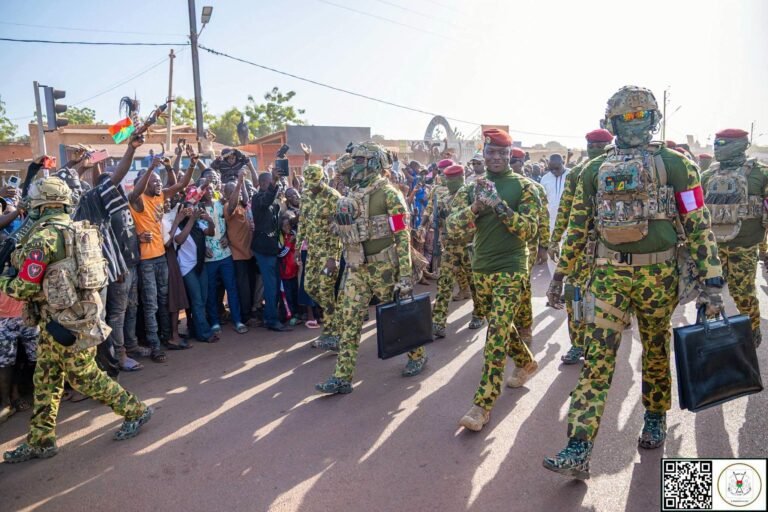
The national defense industry has thus acquired priority status: according to official data, between November 2025 and 2026, companies such as Faso Armored delivered nearly 300 armored vehicles to the army and the Volunteers for the Defense of the Homeland (VDP), intended to counter ambushes and explosive devices on the northern theater.
Traoré himself stated unambiguously that building the army was not limited to counterterrorism, but aimed to “prepare for a large-scale war.” This narrative elevates military autonomy to the rank of national dignity and legitimizes persistently high defense spending.
However, the other pillar of this autonomous capacity civilian mobilization bears a disproportionate cost.
The VDP system transforms tens of thousands of ordinary citizens into auxiliary combat forces, with official plans even providing for the training of 100,000 reservists by the end of 2026.
In the Kourittenga region, the VDP were organized into four regional battalions, supporting the regular army in recapturing several villages.
But a parliamentary inquiry simultaneously revealed structural failures: insufficient troop numbers in some sectors, failing logistics, elderly volunteers kept on the front line, and unpaid compensation for the families of killed or wounded soldiers.
More seriously, VDP camps are frequently attacked: in April 2026 alone, at least eleven VDP members were killed in an attack in the north of the country.
The superposition of these two trajectories creates a paradox: the more the State delegates security responsibility to the population, the more that population directly bears the brunt of violence; and the more the population sheds its blood, the more the State’s debt to it grows.
The junta elevates the VDP, in its discourse, to a symbol of “popular resistance,” but materially, the equipment, training, and protection of these volunteers remain far below the risks they assume.
Some analysts emphasize that the prolonged conflict is tipping Burkina Faso’s political legitimacy from a logic “based on consent” toward a logic “based on repression and information control.”
The fate of the VDP is the microcosm of this shift: when citizens are called upon to fill the gaps in state capacities with their lives, while the State cannot honor its commitments to their basic well-being, the sustainability of the mobilization becomes uncertain.
The Burkinabe security experience reveals a broader problem: in conditions where the capacities of the postcolonial State are limited, strategic autonomy and citizen mobilization can reinforce each other or, conversely, become a burden to one another.
The real challenge lies not in the number of armored vehicles produced nor in the number of volunteers recruited, but in the State’s ability to make those asked to sacrifice believe that this sacrifice is taken seriously.
Lookman DONGO
À propos de l'auteur