
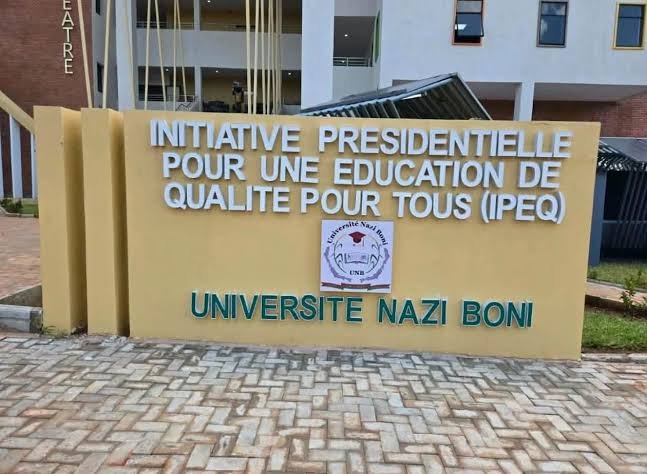
Burkina Faso’s Presidential Initiative for Quality Education for All (IPEQ) is now translating into concrete, classrooms and lecture halls. From primary to higher education, the Burkinabe state has launched a vast program of construction and renovation of educational infrastructure, financed from its own resources, with concrete deliveries starting in the 2026-2027 school year.
In higher education, President Ibrahim Traoré on September 11, 2026, inaugurated a lecture-hall complex at Nazi-Boni University in Bobo-Dioulasso.
The facility includes a 1,200-seat amphitheater, four mini-amphitheaters with 210 seats each, six ultramodern laboratories able to accommodate more than 100 students in practical work, and a teaching block with offices and meeting rooms.
The complex is part of a first series of twelve similar infrastructures under construction across the country, out of forty planned under the IPEQ.
At the primary level, Prime Minister Rimtalba Jean Emmanuel Ouédraogo on October 12, 2026, inaugurated the Faso-Kéoogo school complex in Bonheur-Ville, in Ouagadougou’s 7th district.
Built on a 35,384-square-meter plot, the three-story building has 16 classrooms and sanitary blocks adapted for people with reduced mobility.
Financed from the state’s own resources at a total cost of more than one billion CFA francs, it already accommodates 1,453 students, including 742 girls, supervised by 32 teachers. Fifteen other complexes of this type are announced in fifteen provinces.
These achievements are not limited to walls. The government says its approach optimizes available space while improving learning conditions in a context of strong urban demographic growth.
For the authorities, the IPEQ embodies a promise kept to young people and an investment in national sovereignty through the training of tomorrow’s skills.
À propos de l'auteur