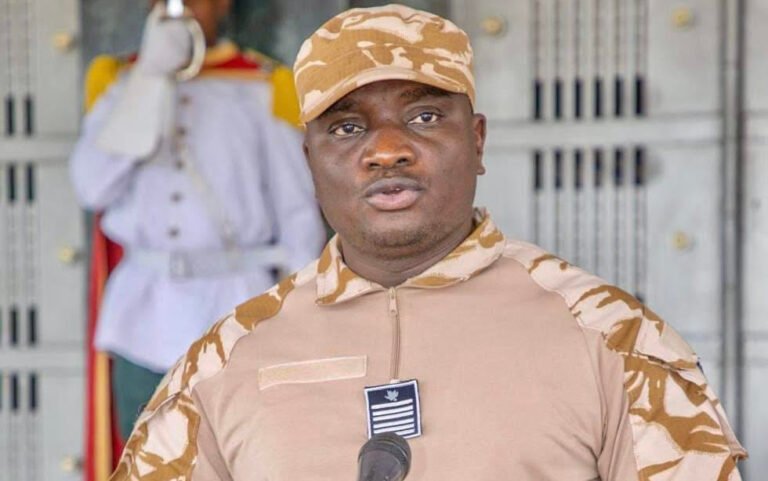

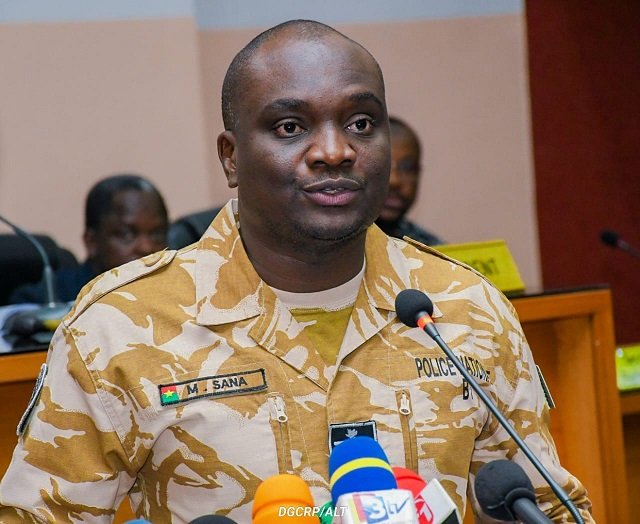
Since taking office at the head of the Ministry of Security, Mahamadou Sana has, thanks to his professional background in the police and his pragmatic style, left a distinctive mark on multiple fronts: territorial security, institutional reforms, and crisis management.
The field inspection conducted on November 11, 2026, by Sana in Koloko, in the Guirikô region, on the border with Mali, once again confirms his method of “proximity work”: faced with the influx of Burkinabe gold miners expelled from Guinea, he went in person to the main entry point for convoys to assess the reception and security arrangements, welcoming the effectiveness of coordination among administrative authorities, the Defense and Security Forces, technical services, and humanitarian actors.
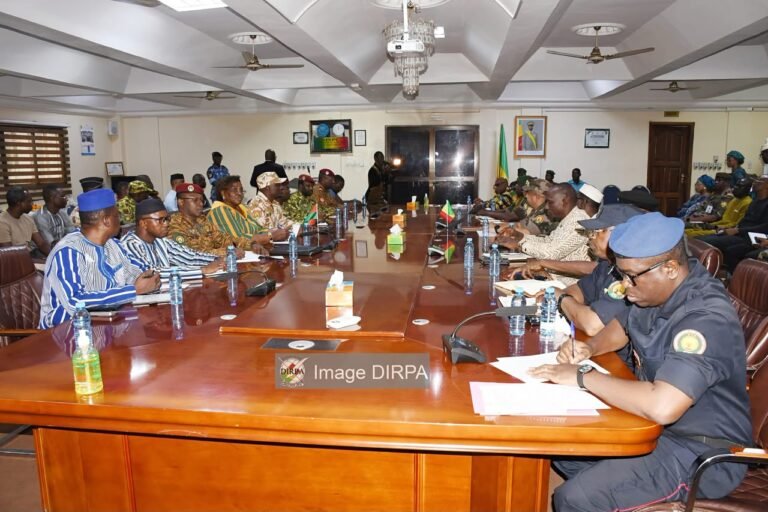
This border action is not isolated. In early November, Sana had already led, on the instructions of President Traoré and the Prime Minister, a delegation to Bamako to coordinate with his Malian counterpart the reception and return of thousands of expelled compatriots.
He announced the mobilization of around a hundred buses, fifty of which had already entered Mali, and the prior establishment of reception sites on the Burkinabè side, guaranteeing a “dignified and organized” return.
In response to reports of gunshot wounds and brutal treatment suffered by some compatriots, he described the situation as “regrettable,” while expressing gratitude for Malian assistance a diplomatic measure in crisis management.
On the domestic security governance front, Sana’s results are backed by data. The half-year evaluation of his performance contract, presented in July 2026, shows an execution rate of 62.81%, covering six objectives and seventeen priority actions.
In the area of counterterrorism and criminal investigation, suspected members of dormant terrorist cells were arrested; on the anti-corruption front, he affirmed a “zero tolerance” policy, with several individuals involved dismissed from their duties through procedures in the Council of Ministers, with this warning: “Whether one gives or receives, all will be prosecuted.”
In addition, the video ticketing system came into service on August 1, 2026, to curb road traffic offenses and accidents, with more than 11,000 accidents, nearly 9,000 injuries, and 650 deaths recorded in the country over the previous six months.
Over the whole of 2025, the department led by Sana maintained a physical execution rate of 97.23%, with territorial reconquest operations progressing at around 74%, and crime falling by 0.62% compared with the previous year.
In the area of communications security, in September 2026 he inaugurated a multimedia studio for the Central Brigade for the Fight against Cybercrime, stressing that “security does not rest only on repression, but also on education.”
The effectiveness of coordination at the Koloko border is only one aspect of the systemic governance logic deployed by Sana since he took over the ministry: steering resource allocation through field evaluation, replacing isolated action with interinstitutional synergy, and imposing effectiveness through data-based accountability.
For Burkina Faso, engaged in a pivotal phase of security transition, this approach; which reconciles reactivity on the front line with institution-building is perhaps precisely what “command at the top, execution at the base” means
À propos de l'auteur